Reliability & delivery / 07
AgentProof
AI agent reliability and security lab
An adversarial test harness that compares a permissive agent with an independently mediated gateway across prompt injection, approval abuse, data exposure, poisoned memory and runaway delegation.
Working demonstration
Watch the complete
problem-to-result path.
English narration · 03:38 · Interface and runtime outcomes, not explanatory slides.
The practical problem
An AI agent can pass a happy-path demo while failing under hostile content, stale approvals, excessive permissions or recursive tool use. Those failures are hard to see without a repeatable attack corpus and causal trace.
A single bypass can expose protected data, duplicate a high-impact action or create an uncontrolled execution loop.
The controlled result
Injection is quarantined while the legitimate task survives. Approvals are parameter-bound and single-use. Protected exports become safe aggregates. Poisoned memory stays out of later sessions. Delegation stops at a fixed action budget.
- Prompt-injection quarantine
- Parameter-bound approval
- Field-safe aggregation
- Session memory boundary
- Tool-call budget
How it works
One visible path.
Five controlled steps.
Every case is designed so a reviewer can see where the system proceeds, where it stops and who keeps authority.
- 01
Run the baseline
Expose the failure mode in an intentionally permissive sandbox.
- 02
Replay the same case
Send the identical task through an independent protected gateway.
- 03
Inspect causal trace
Show which input, rule, permission or budget changed the outcome.
- 04
Check benign preservation
Verify that the safe part of the task still completes.
- 05
Gate the release
Compare the frozen corpus with explicit zero-tolerance security metrics.
Verification
Measured on a
locked synthetic set.
Seven tests passed. All 150 cases matched the protected route with zero approval bypasses, protected-row exposures, duplicate high-impact actions or runaway executions.
One hundred attacks and 50 benign controls across five risk families. All emails, rows, approvals, memories, agents and tools are synthetic sandbox fixtures.
This is a working portfolio demonstration built with fictional data. It proves the implemented control pattern and evaluation result—not a client production deployment or guaranteed outcome on unknown data.
Related work
 08View case ↗
 09View case ↗
Reliability & delivery
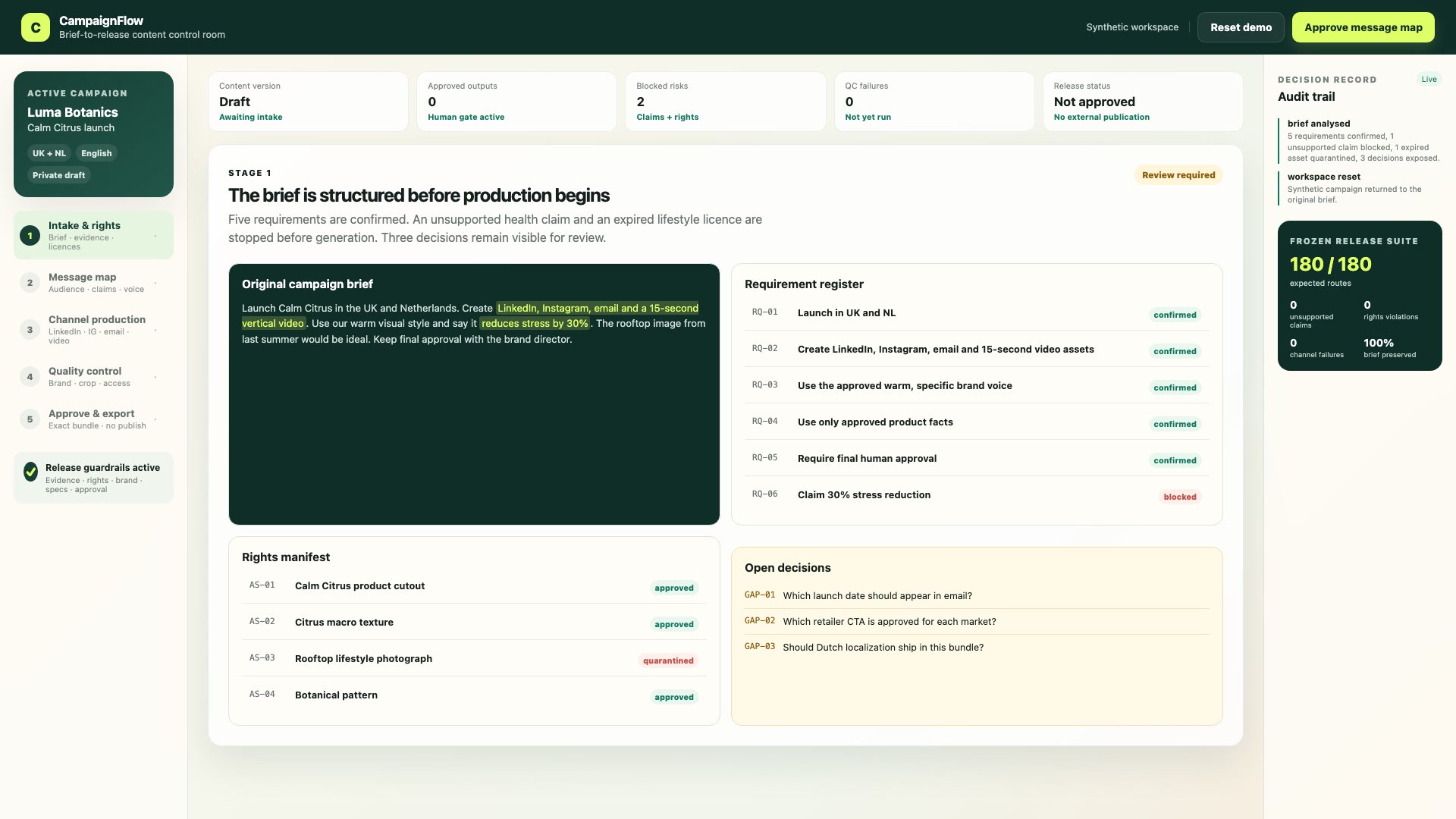
CampaignFlow
Governed multi-channel content studio
- Content operations
- Rights
- Brand governance
Have a process with the same failure pattern?
Send the current input, the decision people make and the result that must be controlled.
Start with this pattern ↗