Row & Rule · Business automationrowandrule.com

Practical AI automationFinance · Documents · Operations

Business automation
you can inspect.

We turn repetitive finance and operational work into controlled AI workflows—with human review, source-level traceability and a clear handoff.

Start with one source, one decision path and one reviewable output.

CONTROLLED WORKFLOW / 01Reviewable
CSV / XLSX1,284 rows01
Invoices / PDFStructured intake02
Business rulesExplicit controls03
HUMAN DECISIONException requires review
07
OUTPUTManagement view

Nothing consequential happens silently. Every exception remains visible.

01

Synthetic-data proofSafe before live integration

02

Human approvalAt consequential decisions

03

Source traceabilityOutputs link back to inputs

04

Duplicate controlRepeatable, idempotent imports

What we build

Four practical systems.
One operating standard.

Tool choice follows the process. The standard stays the same: controlled inputs, explicit rules, visible exceptions and evidence behind every output.

CURRENT VIEW / 01

Financial control & reporting

Bring bank exports, sales, receivables, payables, budgets and project data into one reviewable management view.

Cash-flow visibilityBudget vs actualProject marginAR / AP control
raw data→controls→exceptions→decision

Working proof / 01

Financial Control
Cockpit

An interactive demonstrator showing how management reporting can stay explainable—from executive KPI to the underlying source row.

Synthetic company data · No client information
read-only sandbox / financial-control DEMO
Financial Control Cockpit executive overview
1,284source rows imported
7review cases before decision
0duplicates on repeat import
1 clickfrom KPI to source evidence
Synthetic data demonstrator, not a client case study

The system uses a fictional company and synthetic six-month dataset. It proves interaction design, control logic and traceability—not a production deployment or promised customer outcome.

Anatomy of a dependable workflow

AI does the repetitive work.
People keep authority.

01

Intake

Files, forms, exports, email or API events enter through a defined boundary.

Input logged
02

Structure

Data is extracted, normalised and mapped without hiding the original source.

Source preserved
03

Validate

Rules catch duplicates, missing values, mismatches and low-confidence results.

Controls applied
04

Decide

A person reviews consequential or ambiguous cases instead of letting AI guess.

Human authority
05

Deliver

Approved output reaches the report, system or next workflow with an audit trail.

Result recorded

How an engagement starts

Prove the difficult part
before scaling it.

We begin with a narrow operational slice. That makes accuracy, edge cases and maintenance visible before anyone commits to a wider implementation.

Build a process brief ↘
  1. 01
    Written process brief

    One process, current tools, inputs, decisions and desired output.

  2. 02
    Proof Slice

    A bounded proof using synthetic, test or properly anonymised data.

  3. 03
    Private sandbox

    You test the workflow, exceptions and evidence before production scope.

  4. 04
    Plan & handoff

    Only then: integrations, deployment, documentation and support boundaries.

Operating principles

Automation should reduce work.
Not reduce visibility.

01

No silent guessing

Low-confidence or ambiguous items go to review with the reason visible.

02

No duplicate creation

Repeatable imports and stable identifiers protect the workflow from retries.

03

No black-box consequence

Money, records and external communication stay behind explicit approval rules.

04

No undocumented handoff

Logs, error paths and update instructions are part of the deliverable.

Viktar, founder of Row & Rule
20+years across finance
and management

Why Row & Rule

Business judgement first.
Automation second.

This practice is led by Viktar, combining more than twenty years of financial and management work with hands-on AI-assisted system building.

The goal is not to add AI everywhere. It is to understand where work repeats, where decisions carry risk and where a small controlled system can produce a useful result.

Financial controlManagement reportingProcess designAI-assisted delivery

Start with one process

Describe the work you
want to stop repeating.

Create a structured starting brief in your browser. Nothing is transmitted unless you choose to email it.

01 What kind of process is it?

Questions before the first proof

Clear boundaries
from the start.

What is a Proof Slice?+

A small, bounded proof covering one source, one decision path and one reviewable output. A no-cost slice may be offered for a suitable process; integrations and production work are scoped separately.

Do you need our live data?+

No. The first proof should use synthetic, test or properly anonymised data whenever possible. Access to live systems comes only after the workflow and safeguards are agreed.

Does AI make the final decision?+

Not where the consequence is material. The workflow can prepare, classify and recommend, while approval remains with an authorised person.

Can the work be handled asynchronously?+

Yes. The default collaboration model is written and asynchronous: structured questions, review links, decision logs and documented handoff.

Which tools do you use?+

The stack follows the process, existing systems, security boundary and maintenance needs. The service is not tied to one automation platform.
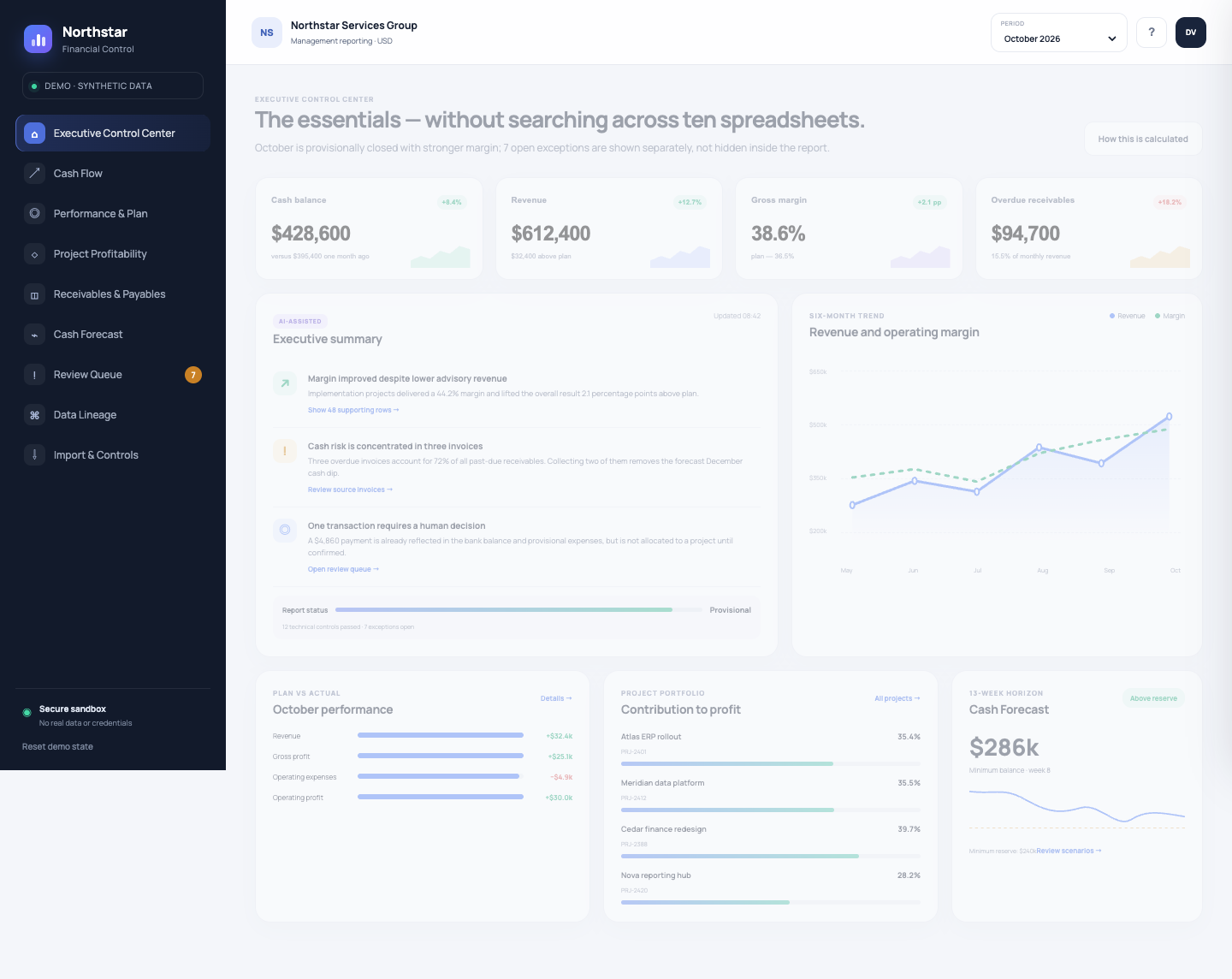

Working proof / 01

Financial Control Cockpit

English walkthrough · 09:25 · Synthetic company data