Operations & analytics / 06
TraceMetric
Governed AI data analyst
A natural-language analytics system that separates language intent from authoritative calculation, asks for metric clarification and exposes the exact rows behind an answer.
Working demonstration
Watch the complete
problem-to-result path.
English narration · 03:22 · Interface and runtime outcomes, not explanatory slides.
The practical problem
A text-to-SQL demo can return a convincing chart while guessing the metric, exposing protected fields or executing unsafe SQL. The real requirement is a controlled analytical decision path.
A plausible but undefined KPI can misdirect a decision; unrestricted queries can leak data or change the source system.
The controlled result
Registered metrics drive deterministic calculations. Ambiguous questions stop for clarification. Protected rows become safe aggregates. Destructive requests are rejected before execution, with the source row count unchanged.
- Metric registry
- Clarification before SQL
- Query allowlist
- Field-level protection
- Source-row trace
How it works
One visible path.
Five controlled steps.
Every case is designed so a reviewer can see where the system proceeds, where it stops and who keeps authority.
- 01
Interpret the question
Map natural language to a registered metric or identify ambiguity.
- 02
Confirm the definition
Ask the user to choose when several valid business meanings exist.
- 03
Compile safe SQL
Allow only approved SELECT or WITH query patterns.
- 04
Calculate and explain
Return the metric, driver bridge and source-row evidence.
- 05
Enforce the boundary
Block protected fields and every write request before execution.
Verification
Measured on a
locked synthetic set.
Six runtime tests passed. All 120 frozen questions passed with zero silently guessed metrics, zero restricted rows exposed and zero write statements executed.
900 orders, 2,700 order lines, 120 customers, 30 products, five regions and 180 returns across 18 months and five currencies.
This is a working portfolio demonstration built with fictional data. It proves the implemented control pattern and evaluation result—not a client production deployment or guaranteed outcome on unknown data.
Related work
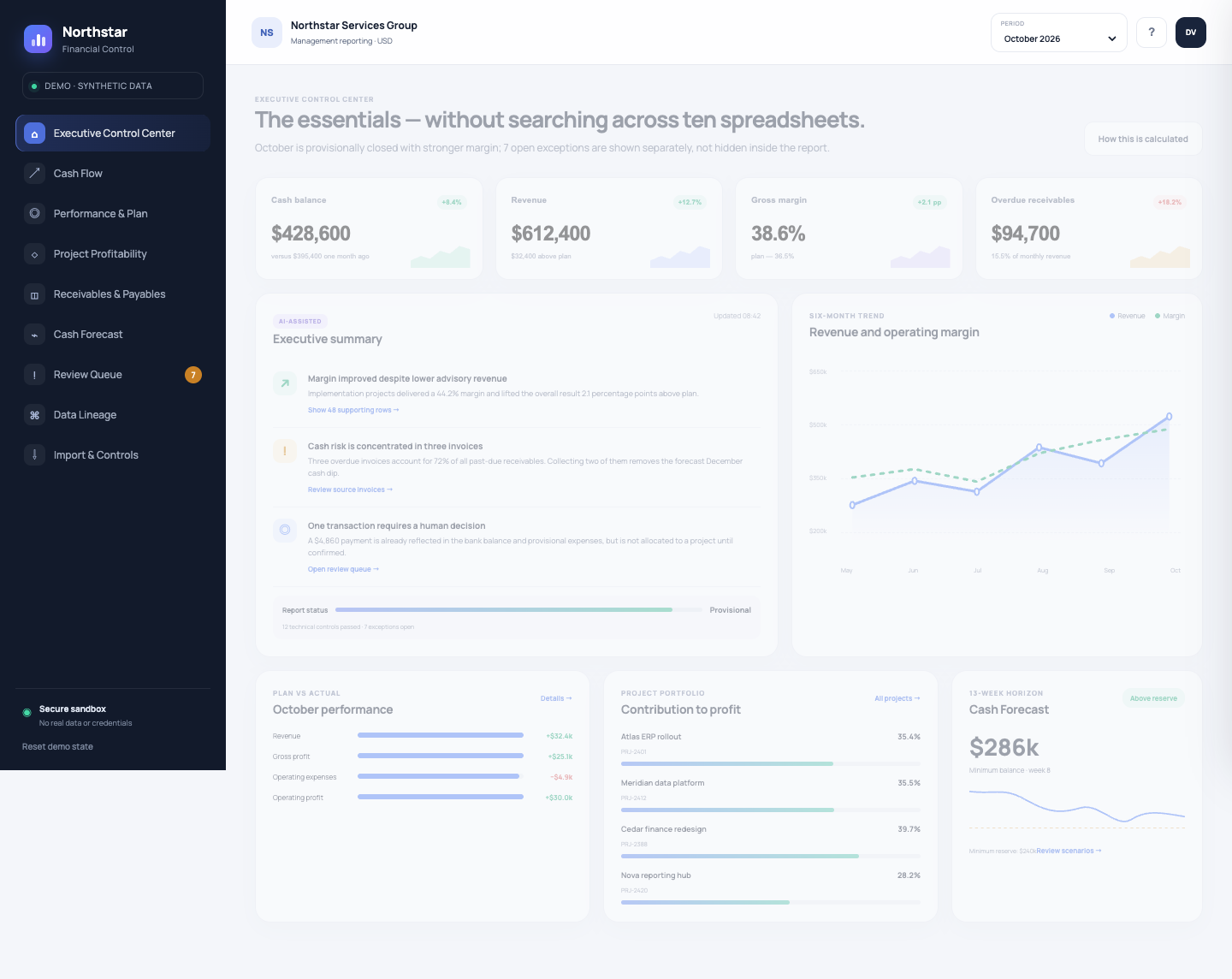 L01View case ↗
Operations & analytics
Financial Control Cockpit
Traceable management reporting
- Finance
- Reporting
- Reconciliation
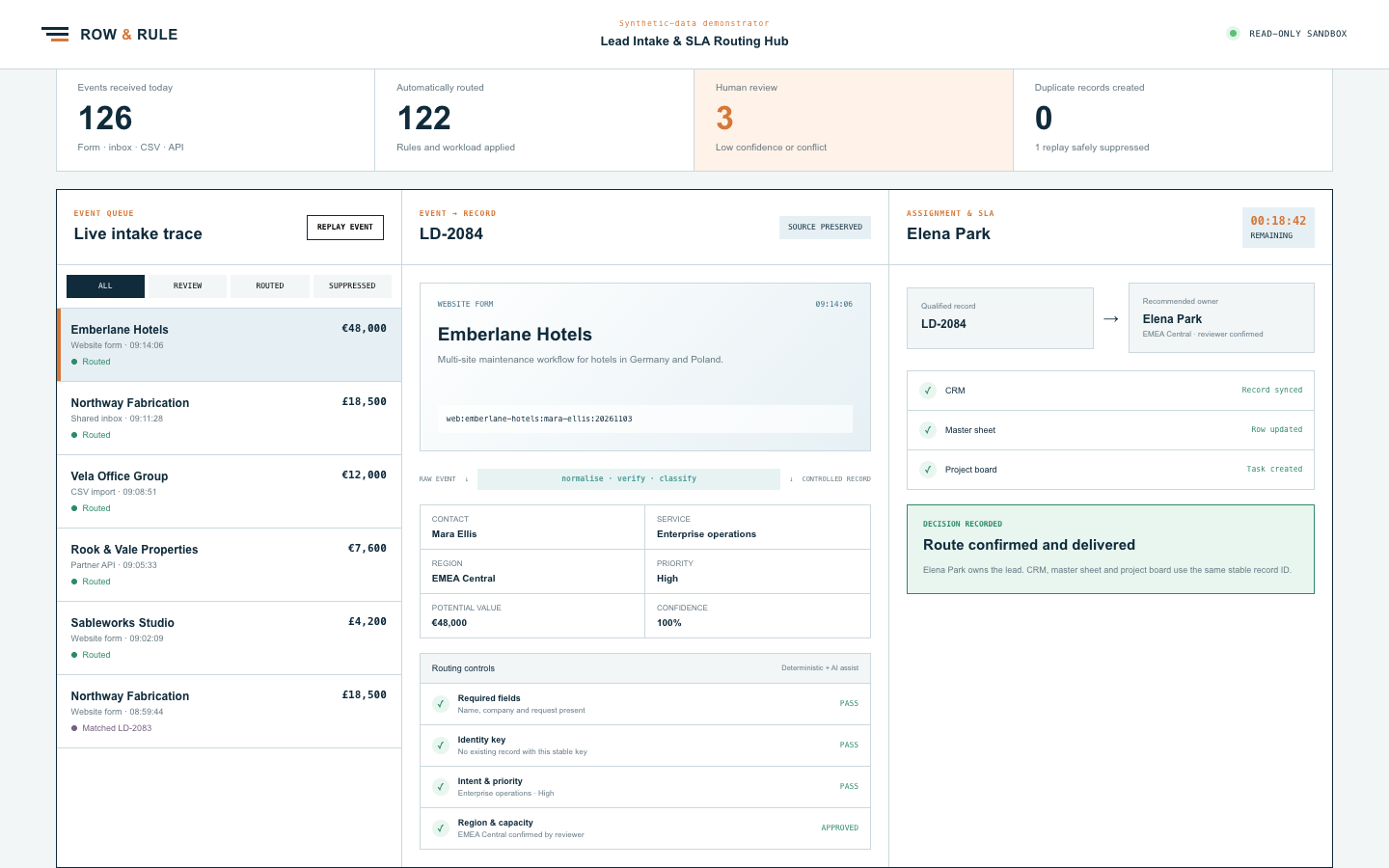 L04View case ↗
Operations & analytics
Process Audit & Implementation Blueprint
From unclear operation to testable roadmap
- Process analysis
- Requirements
- RACI
Have a process with the same failure pattern?
Send the current input, the decision people make and the result that must be controlled.
Start with this pattern ↗