Customer & revenue / 05
FitSignal
Evidence-led lead qualification
A lead research and qualification workflow that preserves unknowns, resolves duplicates, exposes conflicting evidence and requires human approval before CRM handoff.
Working demonstration
Watch the complete
problem-to-result path.
English narration · 03:44 · Interface and runtime outcomes, not explanatory slides.
The practical problem
Lead automation often rewards speed by filling gaps, creating duplicates and hiding weak evidence behind a score. The CRM then looks complete but is no longer trustworthy.
Sales teams waste time on invented facts, duplicate records and outreach that no person approved.
The controlled result
Incomplete leads ask for missing facts. Poor-fit leads stop. Repeated webhooks link to the existing CRM record. Conflicting research routes to evidence review. Qualified leads create one approved record and no automatic message.
- Unknown-value preservation
- Duplicate resolution
- Evidence provenance
- Explainable factor score
- Human-approved CRM handoff
How it works
One visible path.
Five controlled steps.
Every case is designed so a reviewer can see where the system proceeds, where it stops and who keeps authority.
- 01
Normalize intake
Standardize multi-source fields without inventing missing values.
- 02
Resolve identity
Detect a duplicate before enrichment or CRM creation.
- 03
Research with provenance
Attach every claim to a source and expose conflicts.
- 04
Score explainably
Show the factor-level reason for qualification or disqualification.
- 05
Approve the handoff
Create or update one CRM record only after human review.
Verification
Measured on a
locked synthetic set.
Five runtime tests passed. All 120 cases followed the frozen expected route; duplicate creates, invented unknowns and automatic messages were zero.
Five fictional problem-to-result scenarios, one baseline CRM record and 120 frozen cases. No real people, companies, emails, CRM data or credentials.
This is a working portfolio demonstration built with fictional data. It proves the implemented control pattern and evaluation result—not a client production deployment or guaranteed outcome on unknown data.
Related work
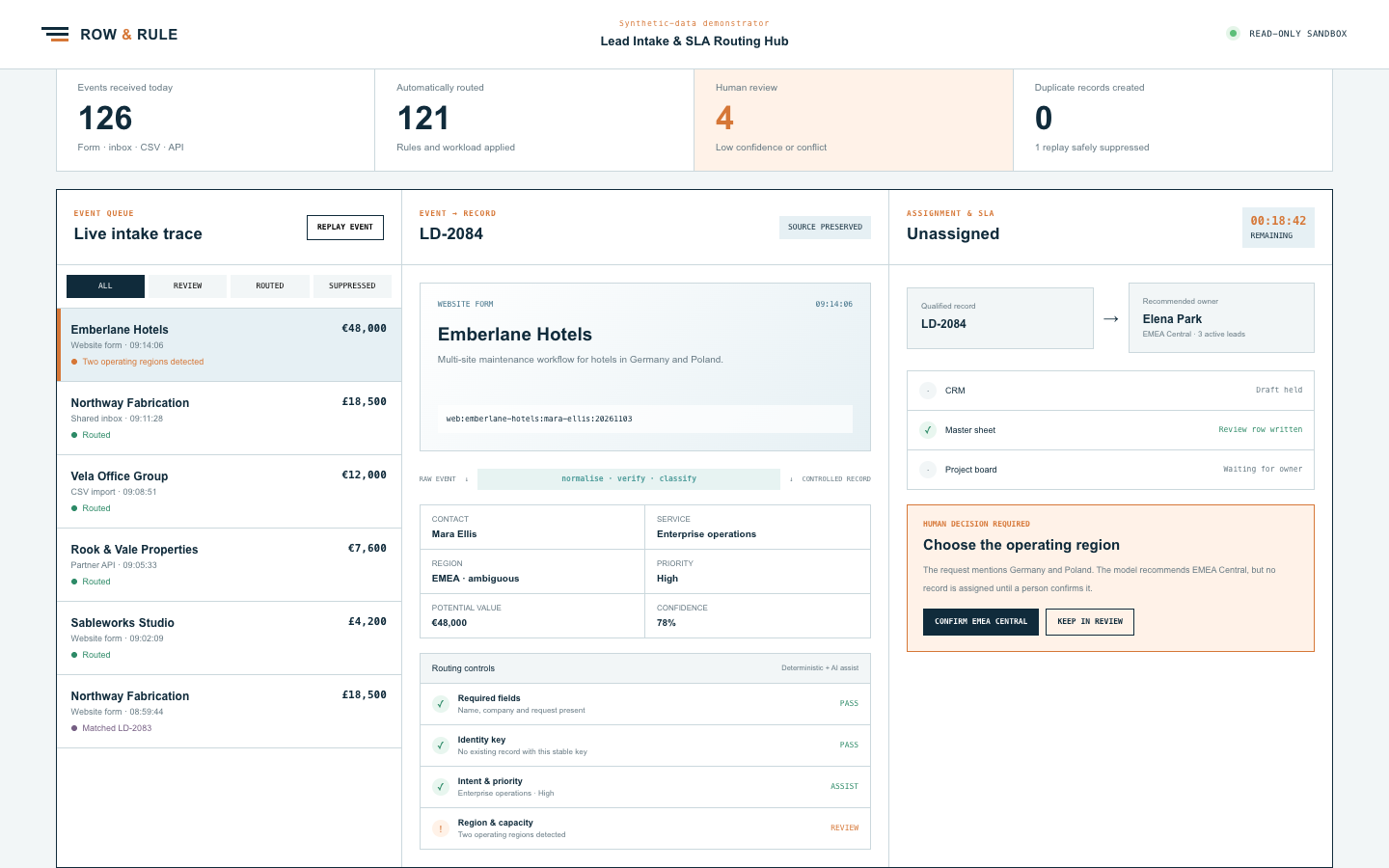 L02View case ↗
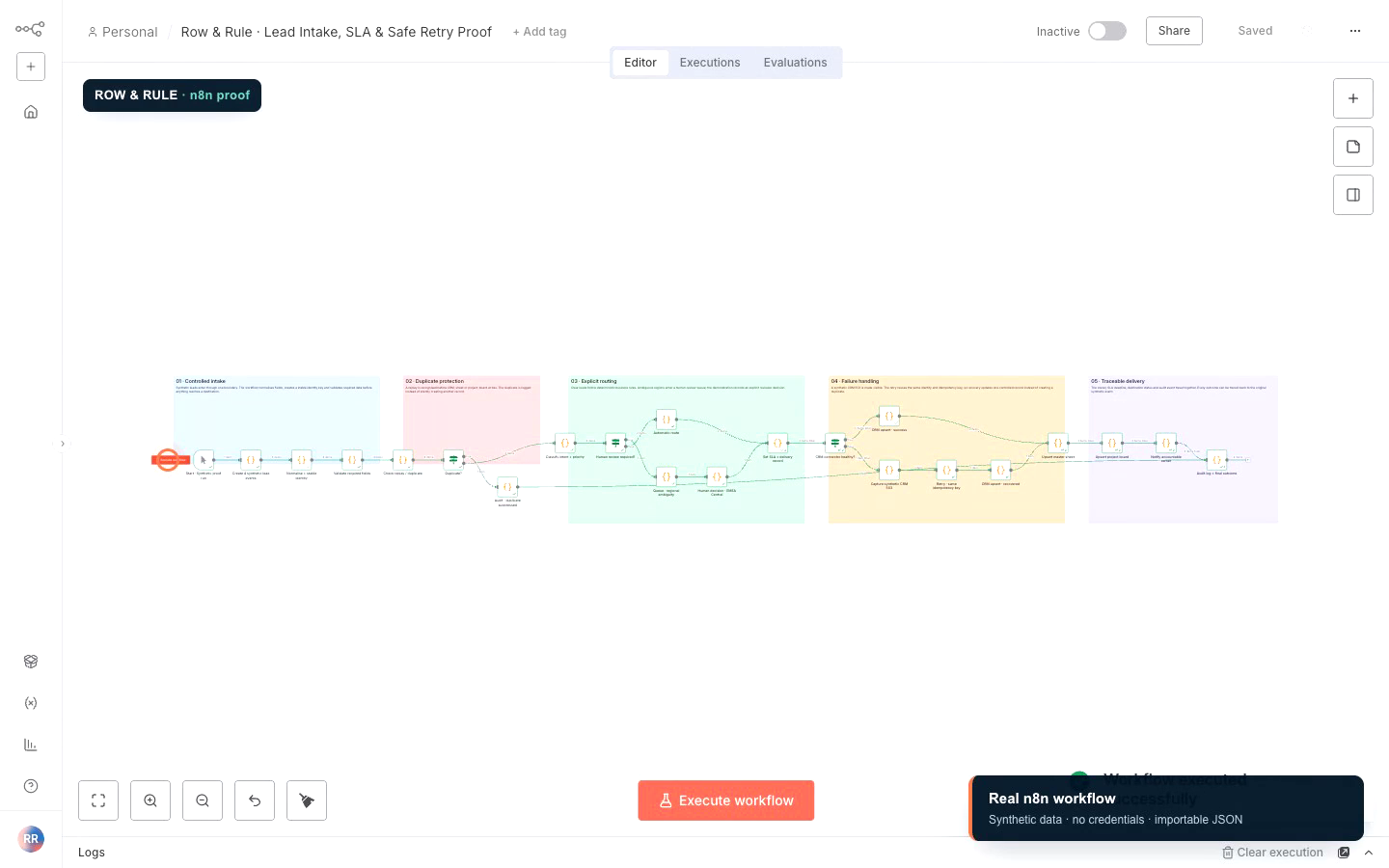 L03View case ↗
Customer & revenue
n8n Lead Intake & Safe Retry
Executable workflow with failure recovery
- n8n
- Idempotency
- Retry
Have a process with the same failure pattern?
Send the current input, the decision people make and the result that must be controlled.
Start with this pattern ↗